
The short answer
A weekly budget is what you can spend each week after bills and savings. Take your monthly pay, subtract monthly bills and savings, multiply by 12 and divide by 52. With $3,400 of pay, $1,493.48 of bills and $300 saved, that's about $370.74 a week. Don't divide by 4: a month is about 4.33 weeks, so the last days come up short. If you're paid weekly, set aside each week's share of the bills first.
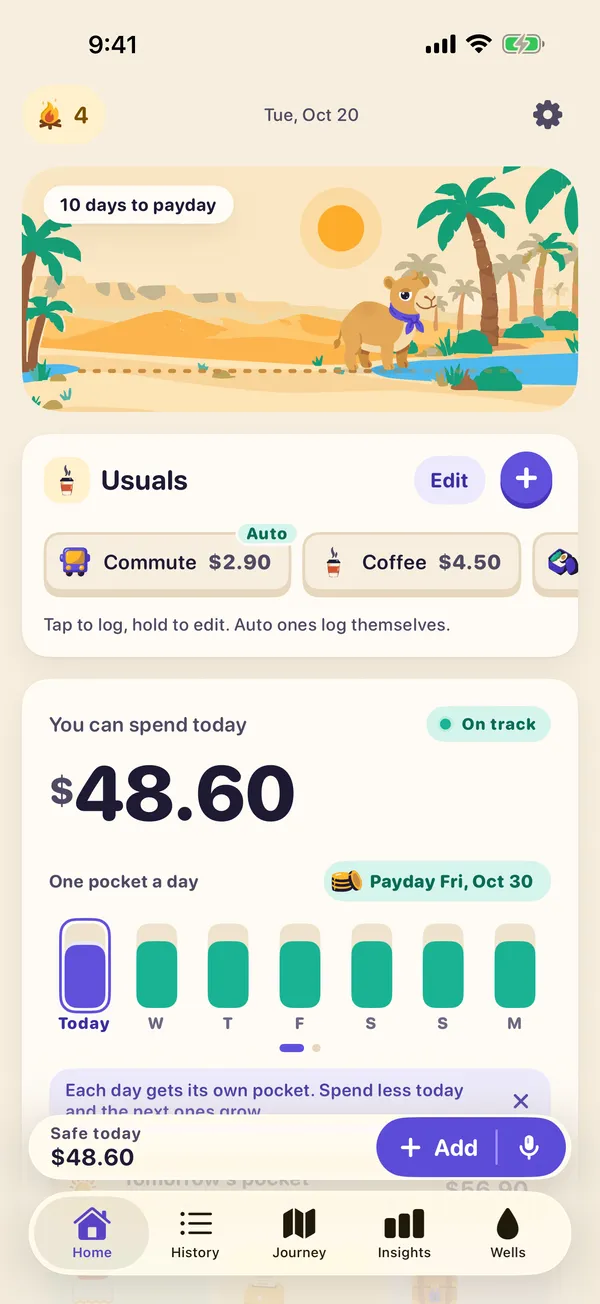
Humph splits your week into daily pockets, so a big Saturday doesn't sink Monday. No bank login, no spreadsheets. For iPhone, with a 7-day free trial.


A weekly budget is the amount you can spend each week on everyday things (groceries, eating out, rides, fun) after your bills and savings are covered. A week is short enough to keep in your head and long enough to plan a grocery run, which is why it works for so many people.
The weekly budget formula
Weekly budget = (monthly pay − monthly bills − monthly savings) × 12 ÷ 52
Multiply by 12 and divide by 52, instead of dividing by 4. A month is a little over four weeks (about 4.33), so dividing by 4 gives you a weekly number that's too big, and the last days of the month come up short.
Example: a weekly budget from monthly pay
Sam takes home $3,400 a month. Bills come to $1,493.48 and Sam saves $300.
- Money to spend each month: $3,400 − $1,493.48 − $300 = $1,606.52
- Weekly budget: $1,606.52 × 12 ÷ 52 = about $370.74 a week
- Divided by 4 instead, it would be $401.63 a week, and Sam would run out before payday.
If you're paid weekly
Then the week is your pay cycle, and the budget is simpler: each paycheck pays its share of the bills, savings come out first, and the rest is the week's money.
Say you take home $785 every Friday and save $75 a week. Your bills are monthly, so set aside their weekly share:
- Bills per week: $1,493.48 × 12 ÷ 52 = $344.65
- Left to spend: $785 − $344.65 − $75 = $365.35 a week, about $52.19 a day
Keep the bill money in a separate account so it's there when rent is due. Paying rent straight out of one weekly paycheck almost never works: rent is often bigger than a whole week's pay. Our budget by paycheck guide shows both ways to handle that.
Weekly budget calculator
This calculator opens on the weekly example: $785 a week, $1,493.48 of bills and $325 a month saved ($75 a week). Change any amount, or pick how often you're paid. It shows the daily amount; multiply by 7 for your week. (It shows $52.04, a little under the $52.19 above, because it spreads the year over all 365 days and 52 weeks cover 364.)
What goes in a weekly budget
Only the spending that changes week to week. Bills and savings are already handled before the weekly number exists.
| In the weekly budget | Not in it |
|---|---|
| Groceries | Rent |
| Lunch, coffee, takeout | Phone bill, internet, insurance |
| Rides, gas, transit fares | Loan and card payments |
| Going out, small treats | Subscriptions |
| Household bits, toiletries | Savings |
A weekly budget template
Copy this into a notes app or a sheet. Write the week's number at the top, then take each buy away from it:
| Day | Spent | Amount | Left this week |
|---|---|---|---|
| Start | $370.74 | ||
| Monday | Groceries | $86.40 | $284.34 |
| Tuesday | Commute, coffee, lunch | $19.40 | $264.94 |
| Wednesday | Commute, lunch | $14.90 | $250.04 |
| Thursday |
Do one quick check midweek: if more than half the money is gone by Wednesday night, the weekend needs to be a cheap one.
The weekend problem
The most common way a weekly budget breaks: Friday and Saturday eat the whole week, and Monday starts at zero. Three fixes:
- Split the week in two. Give Monday to Thursday one half and Friday to Sunday the other.
- Plan the big buy. If the weekend has a birthday dinner or a day trip, decide on Monday what it costs and spend less around it.
- Go daily. A daily budget is a weekly budget cut into seven, and a big Saturday only takes from the days after it.
Weekly, daily or monthly?
| Budget | Good for | Watch out for |
|---|---|---|
| Monthly | Bills, rent, savings | Feels like plenty until week three |
| Weekly | Groceries, a weekly allowance, weekly pay | Weekends can eat the whole week |
| Daily | Everyday spending: food, rides, coffee | Needs a quick daily check |
Questions people ask
Why not divide my monthly budget by 4?
A month has about 4.33 weeks. Dividing by 4 gives you too much each week, and the last days of the month come up short. Multiply by 12 and divide by 52 instead.
How do I budget if I'm paid weekly?
Set aside each week's share of your monthly bills from every paycheck: monthly bills × 12 ÷ 52. Save a fixed amount, and spend the rest over seven days.
How much should I spend on groceries a week?
It depends on where you live and who you feed. Track a month of real grocery buys, take the weekly average, and set your weekly amount from that.
A weekly budget app that thinks in days
Humph takes your pay (weekly, every two weeks, twice a month or monthly), sets bills and savings aside, and gives each day its own pocket until payday. Spend less today and the rest of the week gets more; have a big Saturday and the days after adjust. Log a buy in a tap or just say it. For iPhone, with no bank login and a 7-day free trial.
General information to help you plan, not financial advice. Examples use US dollars; the same steps work in any currency.


