
The short answer
To make your salary last until payday, set bills and savings aside the day you're paid, then spend from a daily amount instead of your balance: what's left, divided by the days until payday. Log every buy the same day, let good days carry forward, and check in each night for 30 seconds. Small buys that repeat, not one big one, are what usually empties the account.
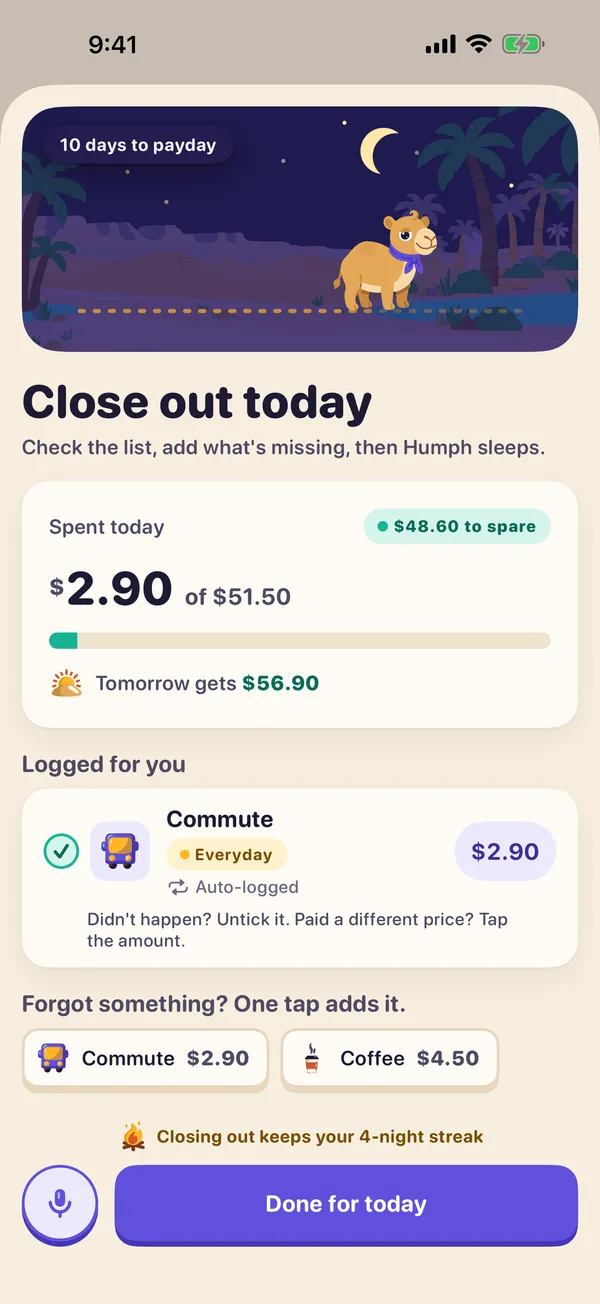
Humph keeps that daily pocket for you and closes each day in a 30-second check-in. No bank login, no spreadsheets. For iPhone, with a 7-day free trial.


If you live paycheck to paycheck, or payday to payday, the last week of every month probably looks the same: a low balance, a few days to go, and no idea where it all went. It's rarely one big buy. It's dozens of small ones you didn't see adding up.
These nine habits make that visible, and they work on any salary.
1. Count from payday to payday
Your money doesn't run from the 1st to the 31st. It runs from the day pay lands to the day the next pay lands. If you're paid on Friday the 30th, your "month" ends on the 29th of next month, and every plan should count those days.
Write down your next payday and how many days away it is. That one number changes how you see every buy.
2. Set bills aside the day pay lands
Rent, phone bill, loan payments and subscriptions will come out whatever you do. Treat them as spent on payday. If your bank lets you, move the total into a separate space or account so it can't be spent by accident.
Watch the due days. A bill due the day before payday is the one most likely to catch you short.
3. Save first, not last
Whatever is left at the end of the month is usually nothing. Move a set amount to savings on payday, even if it's small. $50 every payday is $600 a year you wouldn't have had.
4. Turn the rest into a daily pocket
Take your pay, minus bills, minus savings, and divide by the days until payday. That's your daily pocket.
Pay $3,400 − bills $1,493.48 − savings $300 = $1,606.52 to spend.
Over 30 days, that's $53.55 a day.
A daily number is easy to hold in your head. "Can I afford this?" becomes "does this fit in today's pocket?" Work out yours with the daily budget calculator.
5. Let good days carry forward
A daily pocket isn't a rule you break, it's a pace you keep. If you spend $40 of a $53.55 pocket, the $13.55 you kept spreads over the days ahead. If you spend $80, the extra $26.45 comes out of the days left, so each one gets a little less.
This is what stops one bad day turning into a bad month. You never "fail" a budget; you just adjust the days after.
6. Log every buy the same day
The buys you forget are the ones that empty your account. Log them as they happen, or at least before bed. Keep it fast: if logging takes more than a few seconds, you'll stop.
Small amounts deserve the most attention, because they repeat. A $3.25 snack on 22 workdays is $71.50 a month.
7. Know what your usuals really cost
Your daily commute, your coffee, your lunch: these aren't one-offs, they're a monthly bill paid in pieces. Multiply them out once:
| Usual | Each time | Per month (22 workdays) |
|---|---|---|
| Commute (there and back) | $5.80 | $127.60 |
| Coffee | $4.50 | $99.00 |
| Lunch | $12.00 | $264.00 |
| Total | $490.60 |
You don't have to cut them. Just know they're there, and plan for them, so they stop surprising you.
8. Ask "was it worth it?"
After a bigger buy, ask yourself honestly if it was worth what it cost. Over a few weeks you'll notice a pattern: some splurges you'd buy again, others you regret by the next morning. Those regrets are your easiest savings.
For anything you don't need today, try waiting a day before you buy. If you still want it tomorrow, it'll fit better in tomorrow's pocket anyway.
9. Check in every night for 30 seconds
Before bed, look at three things: what you spent today, anything you forgot to log, and what tomorrow's pocket is. That's it. A daily look keeps small problems small, and it's the habit that makes the other eight stick.
Already short before payday?
If you're reading this with a few days to go and not enough money, start here:
- List what's essential until payday: food, getting to work, medicine. Everything else waits.
- Pause or cancel subscriptions you can live without for now.
- Ask about due dates. Many providers will move a bill's due day closer to your payday if you ask.
- Be careful with expensive short-term credit. High-interest loans can make next month shorter still.
- Plan the next cycle on payday. Bills aside, savings aside, then a daily pocket from day one.
Questions people ask
Why do I always run out of money before payday?
Usually because you spend from your balance. It looks big right after payday, then small buys and a big bill land in the same week. A daily amount shows the cost as you go.
What can I do if I'm out of money days before payday?
Cover essentials first: food, transit, the bill due soonest. Pause subscriptions you can, and plan next payday to set bills aside first.
How do I make my paycheck last two weeks?
Set aside the bills due in those two weeks, save a little, and divide the rest by 14. Spend from that daily amount.
Do it without the math
Humph is an iPhone app built around these habits. It counts from payday to payday, keeps bills aside until they're paid, puts your saving away first and gives you a daily pocket that adjusts as you go. Log a buy in one tap or just say it, close each day in a 30-second check-in, and watch Humph the camel stay on pace with you.
General information to help you plan, not financial advice. Examples use US dollars; the same steps work in any currency.


