
The short answer
If you like PocketGuard's idea, what's left to spend after bills and savings, but not the bank connection or the account, Humph is the closest alternative on iPhone. It splits what's left into a daily amount until your next payday, with no bank login and no account. Humph costs $3.99 a month or $29.99 a year after a 7-day free trial; PocketGuard lists $12.99 a month or $74.99 a year in the App Store. Stay with PocketGuard if you want transactions imported.
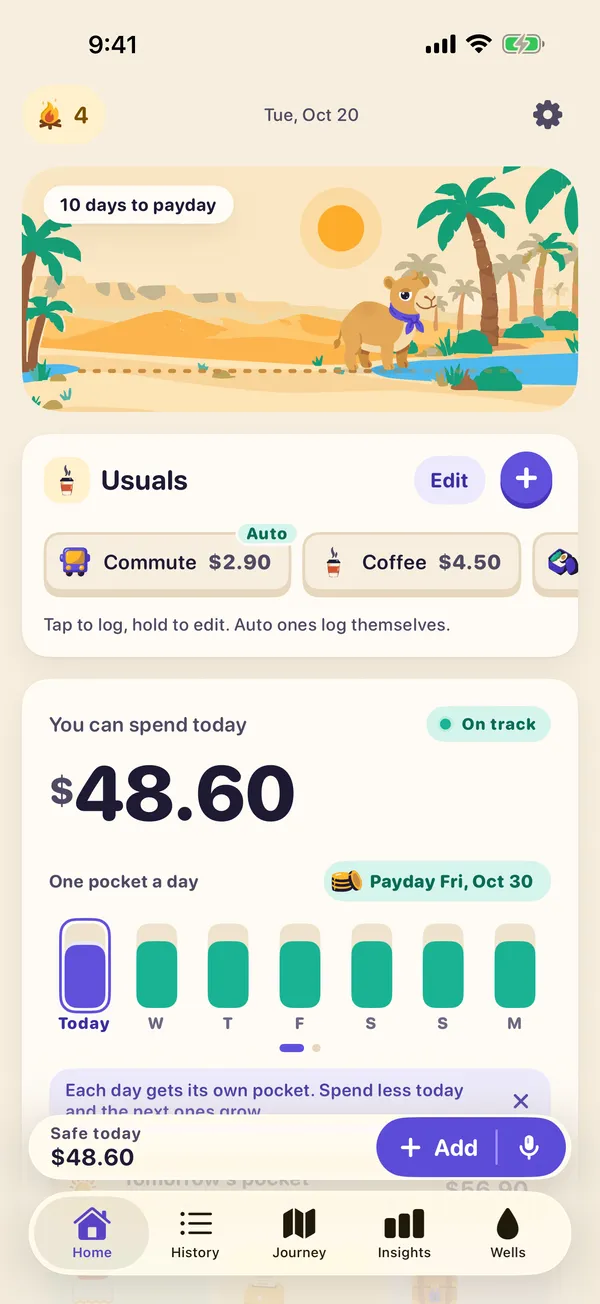
Humph turns what's left into one number for today, with nothing to link. No bank login, no spreadsheets. For iPhone, with a 7-day free trial.


PocketGuard and Humph start from the same question: after bills and savings, what's left to spend? They answer it in different ways. PocketGuard links your bank accounts and tracks what's left for the month. Humph never links a bank and splits what's left into a daily amount until your next payday. Here's how they compare, honestly, and who should stay with PocketGuard.
PocketGuard and Humph side by side
| PocketGuard | Humph | |
|---|---|---|
| The idea | What's left to spend after bills and goals | What's safe to spend today until payday |
| How buys get in | Bank import (US, Canada, UK), or by hand | One tap, the keypad or your voice; regular buys log themselves |
| Bank login | Built around it; you can use it without one | None |
| Account | Needed | None; your data stays on your iPhone and in your iCloud |
| Platforms (App Store listing) | iPhone, Apple Watch | iPhone, with widgets and Siri |
| Free trial | 7 days | 7 days |
| Price | $12.99 a month or $74.99 a year in the App Store | $3.99 a month, $29.99 a year or $59.99 once |
| App Store rating | 4.6 (7,700 ratings) | New |
Why people look for a PocketGuard alternative
PocketGuard has a 4.6-star rating, and plenty of people like it. We read its one- and two-star App Store reviews in October 2026 to see what makes the rest leave. Of 90, 53 were about things a simpler app avoids:
- Bank connections. Accounts that disconnect, transactions that arrive late or twice.
- Sign-up and login trouble. Getting locked out of the account that holds your budget.
- A monthly view. Knowing what's left this month doesn't tell you what's fine to spend today.
Monthly "left to spend" or a daily amount?
Say you have $900 left with 18 days to payday. A monthly number tells you "$900". It looks like plenty on day 1, and that's how week three goes dry. A daily number tells you $50 today. Spend $30 and tomorrow gets $51.18. Spend $80 and tomorrow gets $48.24, so one big night doesn't sink the month.
Humph counts from payday to payday, not by calendar month, so it works the same whether you're paid monthly, twice a month, every two weeks or weekly.
How Humph works
- Bills wait for their day. Rent and the phone bill stay out of your daily amount until they're paid.
- Savings come first. What you save never shows up as spending money.
- Log in a tap, or just say it: "coffee 4.50 and lunch 12" becomes two buys, heard on your iPhone.
- Apple Pay can log itself. A Shortcuts automation offers each in-store payment for you to add.
- A 30-second check-in each night closes the day.
Who should stay with PocketGuard
- You want your transactions imported from your bank automatically.
- You'd rather see the month as one number than a daily amount.
Switching from PocketGuard
- Note your pay after tax and your payday.
- Copy your bills from PocketGuard's bill list, with the day each one is due.
- Pick one amount to save each payday.
- Start logging today. You don't need your history to know what's safe to spend.
Questions people ask
Can I use PocketGuard without linking a bank?
Yes. PocketGuard's App Store page says you can use it without connecting a bank and enter buys by hand. It's built around linked accounts, though.
PocketGuard vs YNAB: which is better?
PocketGuard shows what's left to spend after bills and goals; YNAB asks you to give every dollar a job by category. Both link your bank. YNAB is $109 a year, PocketGuard lists $74.99 a year in the App Store. Pick PocketGuard for a quick answer, YNAB for a detailed plan you review each week.
How much does PocketGuard cost?
Its App Store listing shows $12.99 a month or $74.99 a year, after a 7-day free trial, as of November 1, 2026. Prices may differ by country.
What's the difference between left to spend and safe to spend today?
Left to spend is one amount for the rest of the month. Safe to spend today divides it by the days until payday, so you know what today can take without hurting the days after.
Try a daily number instead
Humph shows what's safe to spend today, every day until payday. For iPhone, with no bank login and a 7-day free trial.
Other apps' prices checked on Nov 1, 2026, in US dollars; check their pages for today's price. General information to help you plan, not financial advice. Examples use US dollars; the same steps work in any currency.


