
The short answer
Budget your first salary from your pay after tax. Set your bills aside the day pay lands, move a fixed saving out next, then divide what's left by the days until payday. That daily amount is what's safe to spend: $3,400 pay minus $1,493.48 of bills and $300 of savings leaves $1,606.52, about $53.55 a day over a 30-day pay cycle. Check it once a day and let tomorrow adjust.
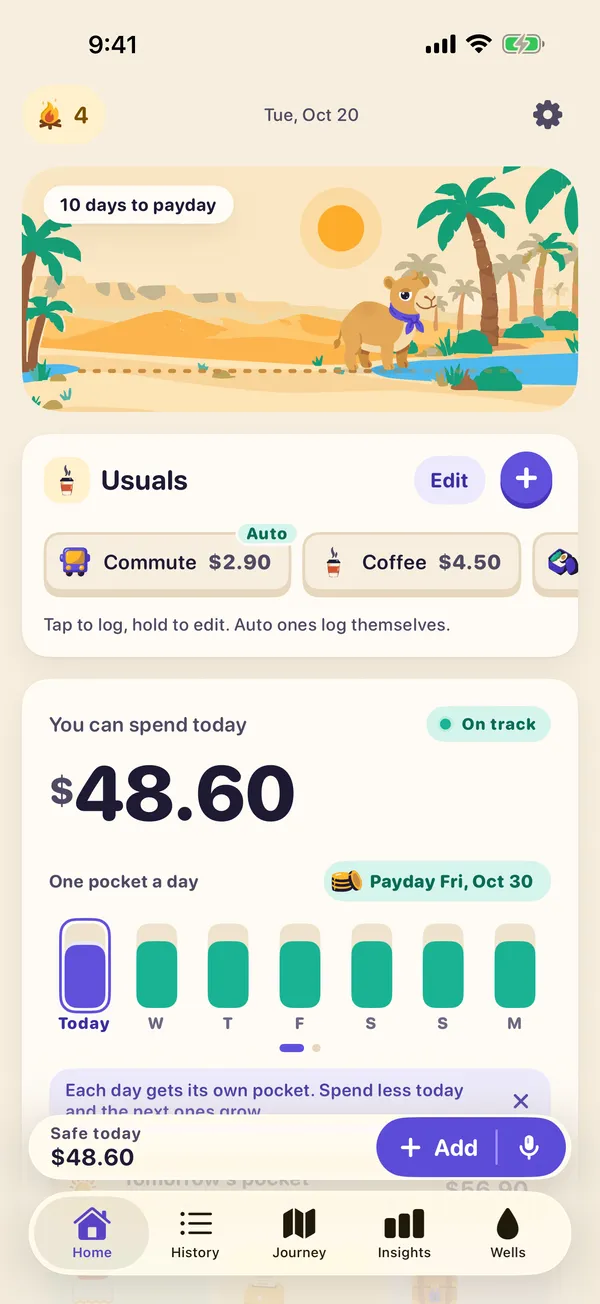
Humph does this split for you and shows today's safe amount on Home, every day until payday. No bank login, no spreadsheets. For iPhone, with a 7-day free trial.


A budget for your first job doesn't need categories, spreadsheets or a finance degree. It needs four numbers: what you get paid, what your bills take, what you want to save, and how many days are left until the next payday. Put them together and you get the only number that matters day to day: what's safe to spend today.
Here's how to build that, step by step, using one example the whole way through.
1. Start from your pay after tax
Budget from the money that actually lands in your account, not the salary in your offer letter. That's your pay after tax and other deductions, often called take-home pay or net pay. You'll find it on your pay slip or in your banking app on payday.
In our example, Sam starts a first job and takes home $3,400 a month, paid on the last working day.
- If your pay changes from month to month (shifts, tips, overtime), budget from your lowest recent payday. Anything above it is a bonus.
- If you're paid twice a month, every two weeks or weekly, plan one pay cycle at a time. The steps are the same; only the number of days changes.
2. List your bills and when they're due
Bills are the payments you make every month whether you like it or not: rent, phone bill, internet, insurance, loan payments, subscriptions. Write each one down with its amount and its due day.
| Bill | Due | Amount |
|---|---|---|
| Rent | Last day of the month | $1,150.00 |
| Loan payment | The 5th | $250.00 |
| Phone bill | The 28th | $45.00 |
| Gym | The 15th | $30.00 |
| Streaming | The 12th | $15.49 |
| Cloud storage | The 3rd | $2.99 |
| Total | $1,493.48 |
The due days matter. A bill due right after payday is easy. A bill due the day before payday is where budgets break, because by then the money has often gone on other things. The fix is simple: set every bill aside the day your pay lands, then treat that money as already spent.
3. Decide what to save before you spend
If you save "whatever's left", you'll usually save nothing. Pick a saving amount at the start of the cycle and move it out of reach, the same day as your bills.
There's no perfect number for a first job. Saving something every payday matters more than the size. Sam starts with $300 a month, about 9% of pay, and puts it toward an emergency fund first: money for a surprise bill, a broken phone or a gap between jobs.
Tip: give each saving a job. "Emergency fund", "a trip", "a new laptop". Money with a name is harder to raid than a vague savings pile.
4. Split the rest into one amount a day
Now take what's left and spread it across the days until your next payday:
Pay after tax − bills − savings = money to spend.
Money to spend ÷ days until payday = what you can spend each day.
For Sam: $3,400 − $1,493.48 − $300 = $1,606.52 to spend this cycle. Over a 30-day pay cycle that's $53.55 a day, for everything else: groceries, lunch, your commute, coffee, rides, the occasional treat.
A daily number works because it's small enough to check in your head. You don't ask "can I afford this this month?", you ask "does this fit in today?" And it adjusts on its own:
- Spend less today and the leftover rolls into the days ahead, so tomorrow gets a little more.
- Spend more today and the extra is spread over the days left, so each one gets a little less. One big day doesn't sink the month.
Want your own number? Try the daily budget calculator.
5. Track every day, in 30 seconds
A budget you only look at on payday is a wish. What keeps it working is a short daily habit:
- Log buys as they happen. The fewer taps, the more likely you'll keep doing it.
- Check in each night. Look at what you spent today, add anything you forgot, and see what tomorrow gets.
- Look back on payday. Where did the money go? Which buys weren't worth it? Change one thing for the next cycle.
Most people quit tracking within a week because logging feels like a chore. Make it as light as you can: one tap for the things you buy all the time, and a quick look at night.
If you're not paid monthly
The method doesn't change, only the cycle length:
- Twice a month (for example the 15th and the last day): plan each half on its own. Split monthly bills between the two paydays by due date, so each pay covers the bills that fall before the next one.
- Every two weeks: you get 26 paydays a year, so two months a year have three paydays. Budget on two, and treat the third as a bonus for savings.
- Weekly: set aside a quarter of each monthly bill every week, so rent is ready when it's due.
Common first-budget mistakes
- Budgeting from your gross salary. Tax and deductions come out first. Always start from pay after tax.
- Forgetting the small regulars. A $4.50 coffee every workday is about $99 a month. Your usuals are a bill in disguise.
- Counting to the end of the month instead of to payday. Your money runs from one payday to the next. Count those days.
- Giving up after one bad day. A big day just makes the next ones a little smaller. Keep going.
- Saving last. Move savings out on payday, with the bills.
Questions people ask
How much of my first salary should I save?
Pick a fixed amount you can keep every payday, then raise it over time. Many people aim for 10% to 20% of pay after tax. Start lower if you need to, and keep it steady.
Should I budget from gross or net pay?
Net pay: the amount after tax and deductions that reaches your account. That's the money you can actually spend.
What bills should a first-job budget include?
Rent, phone bill, transit or car costs, insurance, loan payments and every subscription. Add each one with the day it's due.
Let an app do the counting
You can run this plan in a notebook. Or you can let Humph do it: tell it your pay, your payday, your bills and what you want to save, and it works out what's safe to spend today, every day until payday. It keeps bills aside until they're paid, logs your regular buys on their days, and checks in with you each night for 30 seconds. No bank login, and your numbers stay on your iPhone.
General information to help you plan, not financial advice. Examples use US dollars; the same steps work in any currency.


