
The short answer
Take the money you have left, subtract the bills still to pay and what you want to save, then divide by the days until payday. With $860 left, $500 of rent due and $60 to save over 10 days, you can spend $30 a day. Work it out again each day: spend less today and tomorrow gets more.
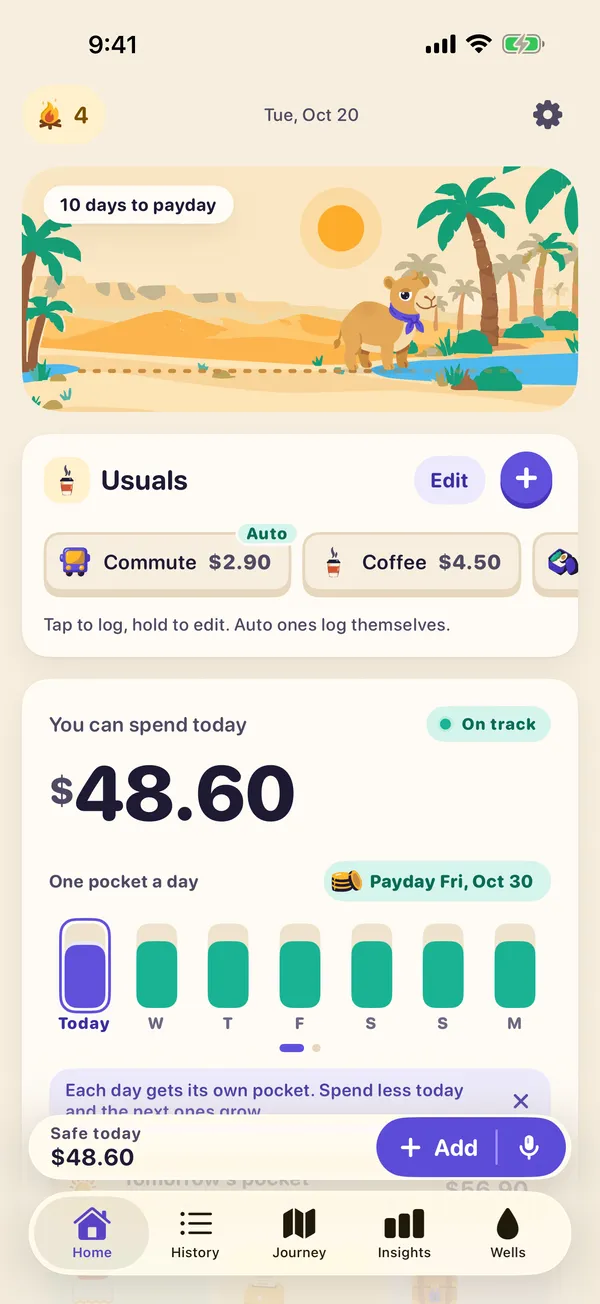
Humph works out your daily number again every time you log a buy. No bank login, no spreadsheets. For iPhone, with a 7-day free trial.


A daily budget is the amount you can spend each day and still make it to payday with your bills paid and your savings untouched. It turns a month of money into one small number you can check at the register.
The daily budget formula
Daily budget = (money left − bills still to pay − savings) ÷ days until payday
At the start of a pay cycle, "money left" is your whole pay after tax. Mid-cycle, it's what's in your account right now.
Daily budget calculator
Type your pay, how often it comes, your monthly bills and what you want to save. The calculator works over a whole year, so it gives a fair daily number for any pay schedule.
Worked examples
At the start of the month
Sam takes home $3,400 a month. Bills come to $1,493.48 and Sam saves $300.
- Money to spend: $3,400 − $1,493.48 − $300 = $1,606.52
- Days until payday: 30
- Daily budget: $1,606.52 ÷ 30 = $53.55 a day
The calculator above shows $52.81 for the same numbers because it uses the average month (365 ÷ 12, about 30.4 days). Your real number depends on how many days your pay cycle has.
In the middle of the month
It's the 20th. Alex has $860 in the account, rent of $500 still to pay, and wants to keep $60 for savings. Payday is in 10 days.
- Money to spend: $860 − $500 − $60 = $300
- Daily budget: $300 ÷ 10 = $30 a day
Daily budget from a yearly salary or an hourly wage
Start from the pay that lands in your account, after tax. Your payslip calls it net pay or take-home pay. Turn it into a monthly number, then use the formula.
- Yearly salary: take-home pay ÷ 12. Taking home $40,800 a year gives $3,400 a month, Sam's example above.
- Hourly pay: weekly take-home × 52 ÷ 12. Jo works 40 hours at $20 and takes home $640 a week: $640 × 52 ÷ 12 = $2,773.33 a month. Take away $1,493.48 of bills and $100 of savings and $1,179.85 is left, about $38.79 a day.
- Hours that change: budget on a slow week. A busy week then adds to savings instead of covering a shortfall.
Don't use the salary in your offer letter. Tax, health cover and retirement payments come out first, so your daily number would be too high.
What happens when a day goes over (or under)
The best daily budgets aren't fixed. They adjust every day based on what you actually spent.
| Day one | Spent | Left | New daily budget (9 days) |
|---|---|---|---|
| On budget | $30.00 | $270.00 | $30.00 |
| Under budget | $18.00 | $282.00 | $31.33 |
| Over budget | $45.00 | $255.00 | $28.33 |
Spend less today and every day after gets a little more. Spend more and the extra is spread thin across the days left, so no single day has to make up for it. Divide what's left by the days left, every day.
Daily, weekly or monthly budget?
| Budget | Good for | Watch out for |
|---|---|---|
| Monthly | Bills, rent, savings goals | Feels like plenty until week three |
| Weekly | Groceries, a weekly allowance | Weekends can eat the whole week |
| Daily | Everyday spending: food, rides, coffee, treats | Needs a quick daily check |
They work best together: plan bills and savings by the month, then spend by the day.
Tips to stay inside your daily budget
- Count your regular buys first. If you buy lunch every workday, that's part of the daily budget, not on top of it.
- Keep a little back. Leave a few dollars of each day unspent and you'll have a cushion for the day something comes up.
- Plan big one-offs. A gift, a repair or a trip is better saved for ahead than squeezed into one day.
- Check in at night. Thirty seconds to see today's total and tomorrow's number keeps you honest.
Questions people ask
How much should I spend a day?
There's no single right number. Take your pay after tax, subtract your bills and savings, and divide by the days until payday. On $3,400 a month with $1,493.48 of bills and $300 saved, that's $53.55 a day over a 30-day month.
Is $50 a day a good budget?
It depends on what the $50 covers. If rent and bills are already set aside, $50 a day for food, rides and fun comes to about $1,521 a month. Compare that with what's left of your pay after bills and savings: if it fits, it's a good budget for you.
Does a daily budget include rent?
No. Set rent and the other bills aside first, plus your savings. The daily budget covers everyday spending: food, rides, coffee and treats.
How do I work out a daily budget in the middle of the month?
Use what's in your account now. Subtract the bills still due before payday and what you want to save, then divide by the days left until payday.
Is a daily spending limit the same as a daily budget?
Close. A limit stays the same every day. A daily budget you work out again each day lets an under day give the next days more, and spreads an over day across the days left.
Get your number every day, automatically
Humph works this out for you every day: it knows your payday, keeps bills aside until they're paid and saves first, then shows what's safe to spend today. Spend less and tomorrow's pocket grows on its own. For iPhone, with a 7-day free trial.
General information to help you plan, not financial advice. Examples use US dollars; the same steps work in any currency.


