
The short answer
A paycheck planner splits each paycheck into three parts: the bills due before your next payday, the savings you move out first, and the rest divided by the days until the next payday. Paid $1,570 every two weeks, with $675 of bills due and $150 saved, you have $745 for 14 days: $53.21 a day.
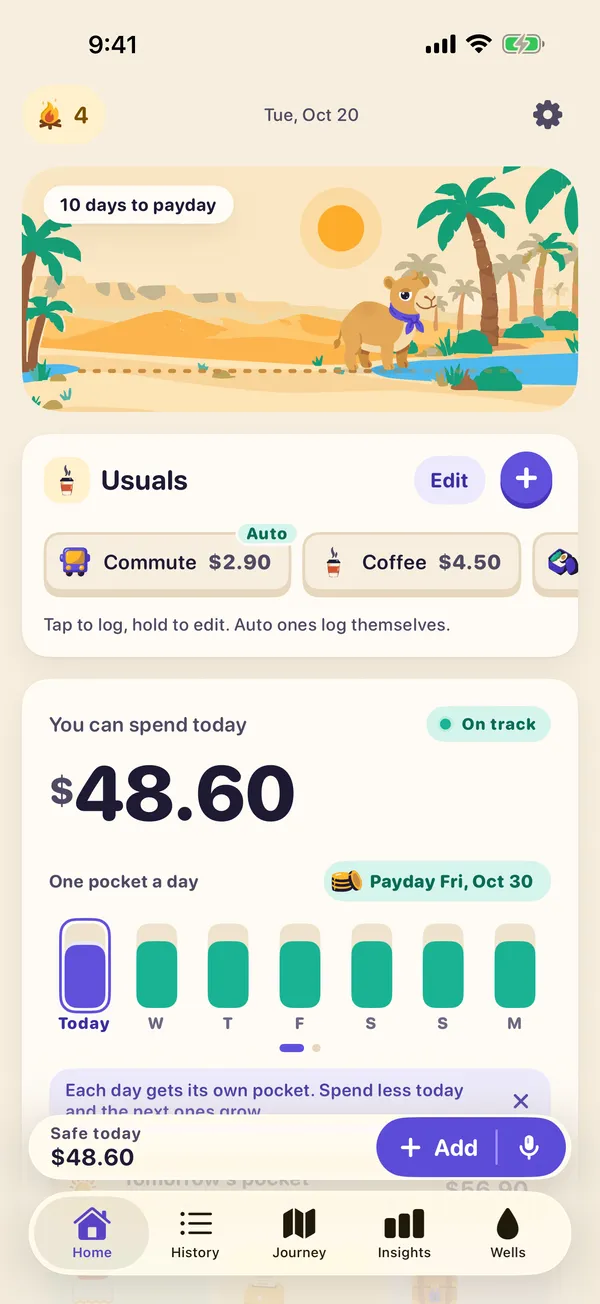
Humph plans every paycheck for you and shows what's safe to spend today. No bank login, no spreadsheets. For iPhone, with a 7-day free trial.


A paycheck planner gives each paycheck its own small plan: the bills it has to cover before the next payday, the savings you move out first, and a daily amount for everything else. You plan one paycheck at a time instead of a whole month, so the plan always matches the money you actually have.
Plan a paycheck in 4 steps
- Write the paycheck and the next payday. Use your pay after tax, the amount that lands in your account.
- List the bills due before the next payday. Only those. A bill due after your next payday belongs to the next paycheck.
- Move savings out the day it lands. Pick one fixed amount, even $25, and treat it like a bill.
- Divide the rest by the days until the next payday. That's your daily amount. Spend less today and tomorrow gets more.
Daily amount = (paycheck − bills due before next payday − savings) ÷ days until next payday
Paycheck budget calculator
Type your pay, how often it comes, your monthly bills and what you save each month. The calculator spreads them over a full year, so it works for weekly, biweekly, twice-a-month and monthly pay.
A paycheck planner to copy
One table per paycheck. Fill it in on payday and you're done until the next one.
| Line | Example (paid every two weeks) |
|---|---|
| Paycheck after tax | $1,570 |
| Next payday | In 14 days |
| Rent share | $600 (half of $1,200) |
| Phone bill | $45 |
| Internet | $30 |
| Savings, moved out first | $150 |
| Left to spend | $745 |
| Daily amount | $745 ÷ 14 = $53.21 a day |
Examples for each pay schedule
Paid weekly
Jordan takes home $720 a week. This week's share of bills is $330 and Jordan saves $50. That leaves $340 for 7 days: $48.57 a day.
Paid twice a month
Riley gets $1,700 on the 15th and on the last day of the month. Rent is $1,100 on the 1st, so Riley sets $550 aside from each paycheck. With $120 of other bills and $150 saved per paycheck, $880 is left for 15 days: $58.67 a day.
Paid monthly
Sam takes home $3,400 on the last day of the month, pays $1,493.48 of bills and saves $300. That leaves $1,606.52 for 30 days: $53.55 a day.
Mistakes that break a paycheck plan
- Planning by calendar month. A month can hold two or three biweekly paychecks. Plan from payday to payday instead.
- Forgetting the bills that come once a year. Set a little aside from each paycheck so the yearly bill doesn't eat one paycheck whole.
- Saving what's left at the end. Usually nothing is left. Move savings out on payday.
- Checking your balance instead of your plan. Your balance still holds the rent. The daily amount doesn't.
Questions people ask
What is a paycheck planner?
A plan for one paycheck at a time: the bills it has to cover before the next payday, what you save, and what's left to spend each day.
How do I plan my paycheck?
Write your pay after tax, list the bills due before your next payday, move your savings out, then divide what's left by the days until the next payday.
How much of each paycheck should go to bills?
As a rough guide, keep needs like rent and bills near half of your pay. If rent alone takes more, set part of it aside from each paycheck.
Is there a free paycheck budget calculator?
Yes, the calculator on this page is free and works for weekly, biweekly, twice-a-month and monthly pay.
A paycheck planner that does the math
Humph sets aside the bills due before each next payday, moves your savings out first and shows what's safe to spend today. Log a buy in a tap or by voice and the number updates. For iPhone, with a 7-day free trial and no bank login.
General information to help you plan, not financial advice. Examples use US dollars; the same steps work in any currency.


