
The short answer
To budget biweekly pay, plan each month on two paychecks, set aside half of your monthly bills from each one, save a fixed amount, and divide the rest by 14 days. With $1,570 every two weeks, $1,493.48 of bills and $150 saved per paycheck, that's $673.26, or $48.09 a day. Two months a year a third paycheck arrives with no bills to pay: give it a job before it lands.
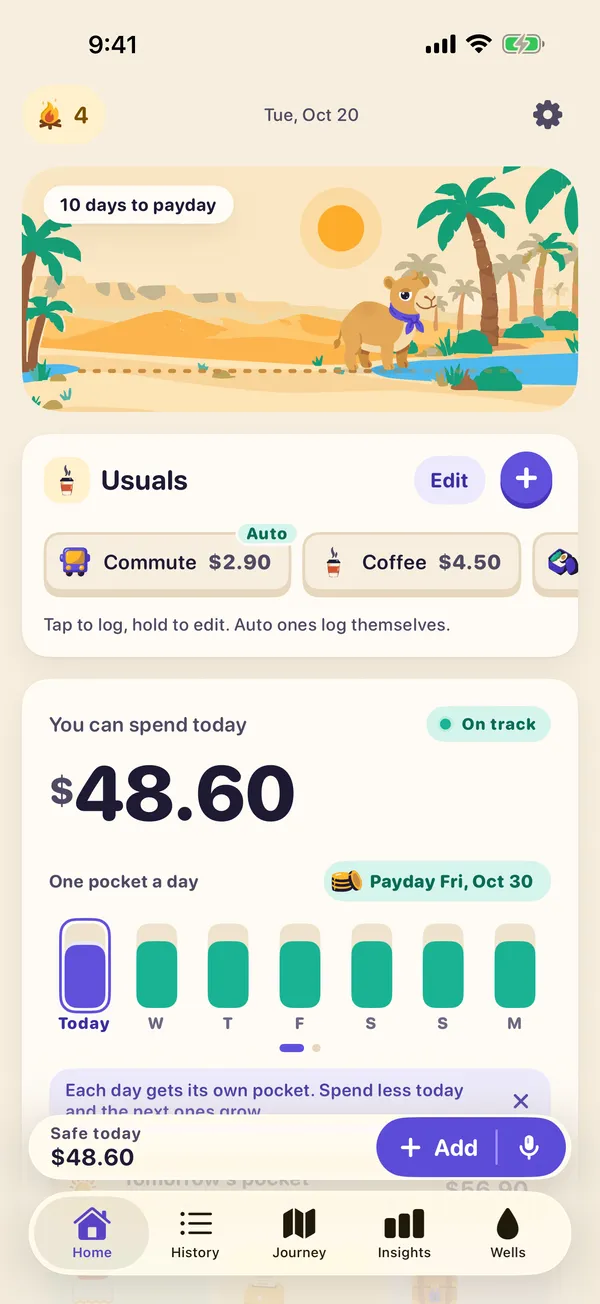
Humph counts every biweekly payday for you, including the three-paycheck months. No bank login, no spreadsheets. For iPhone, with a 7-day free trial.


Biweekly pay means you're paid every other week: 26 paychecks a year, on the same weekday. Most bills come monthly, so the trick of a biweekly budget is matching two rhythms that don't line up. Here's how to do it, with an example, a calculator and the 2027 months when you get a third paycheck.
Biweekly or twice a month?
They sound the same and they aren't:
| Every two weeks (biweekly) | Twice a month (semi-monthly) | |
|---|---|---|
| Paydays a year | 26 | 24 |
| Payday falls on | The same weekday, often Friday | Set dates, often the 15th and the last day |
| Paychecks a month | Usually 2, sometimes 3 | Always 2 |
Turn biweekly pay into a monthly number
Sam takes home $1,570 every other Friday. There are two honest ways to think about it per month:
- The average: $1,570 × 26 ÷ 12 = $3,401.67 a month. Right over a year, but most months you only get $3,140.
- The two-paycheck month: $1,570 × 2 = $3,140. Budget on this, and the two months with a third paycheck become a bonus.
If money is tight, budget on two paychecks. It's the safer plan: no month ever has less than you planned for.
How to budget biweekly pay
- Budget on two paychecks a month ($3,140 for Sam).
- Split your monthly bills in half. Each paycheck sets aside half: $1,493.48 ÷ 2 = $746.74. Keep it in a separate account and pay each bill from there.
- Save from every paycheck. Sam saves $150 each time.
- Divide the rest by 14 days. $1,570 − $746.74 − $150 = $673.26, or $48.09 a day until the next payday.
- Plan the third paycheck before it arrives (see below).
Splitting bills in half keeps every paycheck the same, even the one that lands right before rent. If you'd rather give each bill to the paycheck before its due date, our budget by paycheck guide walks through that method and its rent-week problem.
Biweekly budget calculator
It opens on Sam's numbers: $1,570 every two weeks, $1,493.48 of bills and $325 a month saved ($150 a paycheck). Change any amount. This calculator uses the yearly average, all 26 paychecks, so its daily number ($52.04) is higher than the two-paycheck plan above ($48.09). The difference is the third paycheck, spread across the year.
Three-paycheck months in 2027
Most years, two months have three paydays (some years, three). Which months depends on your pay dates:
| If your paydays include | Three-paycheck months in 2027 |
|---|---|
| Friday, October 2, 2026 | April (2, 16, 30) and October (1, 15, 29) |
| Friday, October 9, 2026 | January (1, 15, 29), July (2, 16, 30) and December (3, 17, 31) |
On the second schedule, 2027 has 27 paydays instead of 26, which happens about once every 11 years.
If you budget on two paychecks, the third one has no bills to pay. Good uses, in order:
- Build or refill an emergency fund.
- Get a month ahead on rent, so the next tight month isn't tight.
- Pay down a card or loan.
- Save toward something you want.
A biweekly budget template
Copy this and fill one row per payday:
| Payday | Pay | Half of bills | Save | To spend | Per day |
|---|---|---|---|---|---|
| Fri, Oct 2 | $1,570.00 | $746.74 | $150.00 | $673.26 | $48.09 |
| Fri, Oct 16 | $1,570.00 | $746.74 | $150.00 | $673.26 | $48.09 |
| Fri, Oct 30 |
How to save money on a biweekly paycheck
Biweekly pay hands you a saving plan for free: two paychecks a year that no bill is waiting for. Sam's plan:
- Save the day pay lands. $150 from each of the 24 regular paychecks is $3,600 a year. Move it before you spend anything, so it never shows in your daily number.
- Save the third paychecks whole. Two extra paychecks of $1,570 add $3,140. Together that's $6,740 a year on a $40,820 take-home.
- Raise it with your pay. When a raise lands, add half of it to the saving and spend the other half.
If $150 feels too big, start with $25 a paycheck. That's $650 a year, and the habit counts for more than the amount.
Common biweekly budget mistakes
- Budgeting on the yearly average. $3,401.67 a month sounds right, but most months bring $3,140.
- Spending the third paycheck by accident. Give it a job before it lands.
- Paying rent from one paycheck. For many people rent is most of a paycheck. Set half aside from each one.
- Treating it like twice a month. Your paydays drift through the month, so a bill that was easy in March can be tight in May.
Questions people ask
How do I budget biweekly paychecks for monthly bills?
Add up your monthly bills and set half aside from each paycheck. With $1,493.48 of bills, that's $746.74 per paycheck. Pay each bill from that money when it's due, and every paycheck stays the same size.
How many biweekly paychecks are in a year?
26 in most years. About once every 11 years, a year has 27, depending on your pay dates. 2027 has 27 if one of your paydays was Friday, October 9, 2026.
How do I work out my monthly income from biweekly pay?
Multiply one paycheck by 26 and divide by 12. $1,570 every two weeks averages $3,401.67 a month. Most months only bring two paychecks, $3,140, so budget on that.
How can I save money on a biweekly paycheck?
Move a fixed amount out the day each paycheck lands, before you spend, and save the two third paychecks whole. $150 a paycheck plus two third paychecks of $1,570 saves $6,740 a year.
Which paycheck should pay rent?
Either works if you plan for it. The simplest way is to set half of the rent aside from each paycheck. If you give rent to one paycheck, set part of it aside from the one before, so rent week isn't tight.
A budget app for biweekly pay
Humph knows you're paid every two weeks. Pick one real payday and it counts every one after it, including the three-paycheck months. On each payday it sets aside the bills due before the next one, saves first, then shows what's safe to spend today. For iPhone, with no bank login and a 7-day free trial.
General information to help you plan, not financial advice. Examples use US dollars; the same steps work in any currency.


