
The short answer
To budget by paycheck, give each paycheck the bills due before the next payday, move your savings out the day it lands, then divide what's left by the days until the next payday. Paid $1,570 every two weeks, with $298.48 of bills due and $150 saved, you have $1,121.52 for 14 days: $80.11 a day. When one paycheck has to cover rent, set part of the rent aside from the paychecks before it.
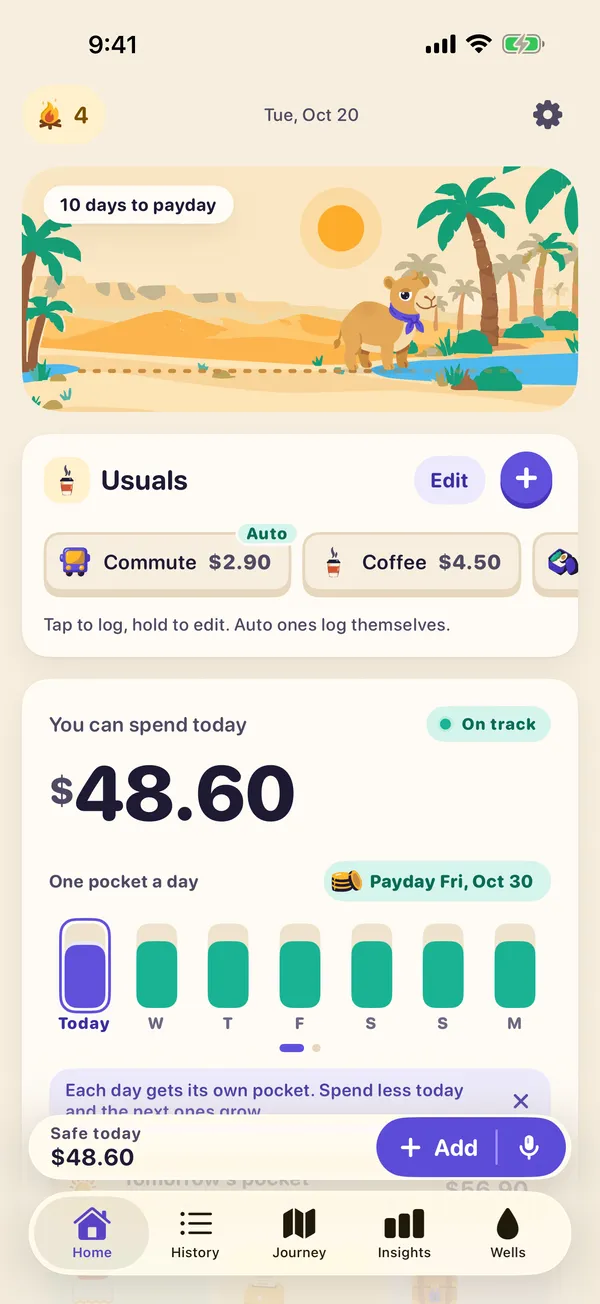
Humph sets aside the bills due before each next payday for you and shows what's safe to spend today. No bank login, no spreadsheets. For iPhone, with a 7-day free trial.


Budgeting by paycheck means you plan one paycheck at a time instead of one month at a time. Each paycheck pays the bills that are due before the next payday, puts a little into savings, and the rest is what you can spend until more money lands. If you're paid every two weeks, twice a month or weekly, this fits your money much better than a monthly budget.
Here's how to do it in five steps, with a calculator, a planner table you can copy, and one example the whole way through.
How to budget by paycheck in 5 steps
- Write down your paydays. List the next few dates your pay lands and how much lands each time: your pay after tax, the amount that actually reaches your account.
- List your bills with their due days. Rent, phone bill, loan payments, subscriptions, insurance. The due day decides which paycheck pays each one.
- Give each bill to a paycheck. Each paycheck covers every bill due on or after its payday and before the next payday.
- Save first, every payday. Pick a fixed amount and move it out the day your pay lands. Small and steady beats big and rare.
- Divide what's left by the days until the next payday. That's your daily number: what's safe to spend each day on food, rides, coffee and everything else.
Paycheck − bills due before the next payday − savings = money to spend.
Money to spend ÷ days until the next payday = what you can spend each day.
Paycheck budget calculator
Type your pay after tax, how often it comes, your monthly bills and what you want to save each month. The calculator spreads everything over a whole year, so it gives a fair daily number for any pay schedule. It opens on Sam's numbers from the example below: $1,570 every two weeks, $1,493.48 of bills and $325 a month saved ($150 a paycheck).
This is your average day. The real number moves from paycheck to paycheck, because bills don't fall evenly. The example below shows why.
Example: paid every two weeks
Sam takes home $1,570 every other Friday and saves $150 from each paycheck. Sam's bills come to $1,493.48 a month:
| Bill | Due | Amount |
|---|---|---|
| Cloud storage | The 3rd | $2.99 |
| Loan payment | The 5th | $250.00 |
| Streaming | The 12th | $15.49 |
| Gym | The 15th | $30.00 |
| Phone bill | The 28th | $45.00 |
| Rent | Last day of the month | $1,150.00 |
Paydays fall on October 2, October 16, October 30 and November 13. Give each bill to the paycheck before it:
| Paycheck | Bills it pays | Bills | Left after $150 saved | Per day (14 days) |
|---|---|---|---|---|
| Fri, Oct 2 | Cloud storage, loan, streaming, gym | $298.48 | $1,121.52 | $80.11 |
| Fri, Oct 16 | Phone bill | $45.00 | $1,375.00 | $98.21 |
| Fri, Oct 30 | Rent, cloud storage, loan, streaming | $1,418.48 | $1.52 | $0.11 |
| Fri, Nov 13 | Gym | $30.00 | $1,390.00 | $99.29 |
Three paychecks feel easy. One leaves 11 cents a day. That third row is why so many people run out of money before payday even when their budget works on paper: rent and the loan land in the same two weeks.
When one paycheck can't cover a big bill
You have two fixes. Pick the one that matches how you like to think about money.
Fix 1: put part of the big bill aside early
Keep the due-date plan, but move some of the rent out of the easy paychecks. If Sam puts $500 aside on October 2 and $500 on October 16, the October 30 paycheck only needs to find $150 of the rent:
- October 2: $1,121.52 − $500 = $621.52, about $44.39 a day
- October 16: $1,375.00 − $500 = $875.00, $62.50 a day
- October 30: $1.52 + $1,000 = $1,001.52, about $71.54 a day
Fix 2: split every bill evenly
Set aside the same share of your bills from every paycheck, whatever is due. With 26 paychecks a year:
Bills per paycheck = monthly bills × 12 ÷ 26
$1,493.48 × 12 ÷ 26 = $689.30
Now every paycheck looks the same: $1,570 − $689.30 − $150 = $730.70, or $52.19 a day, every cycle. (The calculator above shows $52.04 for the same numbers because it spreads them over all 365 days of the year, and 26 paychecks cover 364.) Keep the bill money in its own account and pay each bill from there when it's due. The catch: the first month needs a head start, because rent can come due before the bill account has filled up.
A paycheck planner you can copy
Copy this into a notes app or a sheet and fill one row per payday. It's the whole paycheck budget template:
| Payday | Pay | Bills due before next payday | Bills | Save | To spend | Days | Per day |
|---|---|---|---|---|---|---|---|
| Oct 2 | $1,570.00 | Cloud storage, loan, streaming, gym | $298.48 | $150.00 | $1,121.52 | 14 | $80.11 |
| Oct 16 | $1,570.00 | Phone bill | $45.00 | $150.00 | $1,375.00 | 14 | $98.21 |
| Next payday |
Each night, take what you spent today away from "To spend", then divide what's left by the days left. Spend less today and tomorrow gets a little more.
Every pay schedule, the same method
- Every two weeks: 26 paydays a year, so two months a year have three. With the due-date plan, the third paycheck usually has few bills: a good one for savings or a head start on rent.
- Twice a month (often the 15th and the last day): bills due from the 15th to the end of the month come from the mid-month paycheck, the rest from the end-of-month one.
- Weekly: 52 paydays, about four a month. Give each bill to the week it falls in, or use the even split: monthly bills × 12 ÷ 52.
- Monthly: one paycheck pays everything. Budgeting by paycheck and budgeting by month are the same thing.
If you live paycheck to paycheck
A paycheck plan helps most when money is tight, because it shows the bad cycle before you're in it. Start with the bills and the daily number, even if savings is $0 for now. Once one cycle ends with money left, keep that amount as your first cushion and save a little from the next paycheck.
Questions people ask
What is the 50/30/20 rule for a paycheck?
It splits pay after tax into 50% for needs, 30% for wants and 20% for savings. On a $1,570 paycheck that's $785, $471 and $314. If rent alone takes more than half, start from your real bills instead.
How do I budget a biweekly paycheck?
Set aside monthly bills × 12 ÷ 26 from each paycheck, save a fixed amount, and divide the rest by 14 days. Two months a year bring a third paycheck.
What if one paycheck has to cover rent?
Put part of the rent aside from the paychecks before it, so the rent paycheck isn't left with a few dollars a day.
How much of my paycheck should I save?
Start with a fixed amount you won't miss, even $25 to $50, and move it out the day your pay lands. Raise it when you get a raise.
Let an app do the paycheck math
Humph budgets by paycheck for you. Tell it when you're paid (monthly, twice a month, every two weeks or weekly) and add your bills with their due days. On every payday, Humph sets aside the bills due before the next one, saves first, then shows what's safe to spend today. Log a buy in a tap or just say it, and the number updates. For iPhone, with no bank login and a 7-day free trial.
General information to help you plan, not financial advice. Examples use US dollars; the same steps work in any currency.


