
The short answer
To stop impulse buying, check what's safe to spend today before you shop, wait a day for anything above a limit you pick, delete saved cards from shopping apps, and give fun money its own amount. Rate each extra a day later: was it worth it? With $900 left and 18 days to payday, a $40 unplanned buy drops every day after from $50 to $47.65.
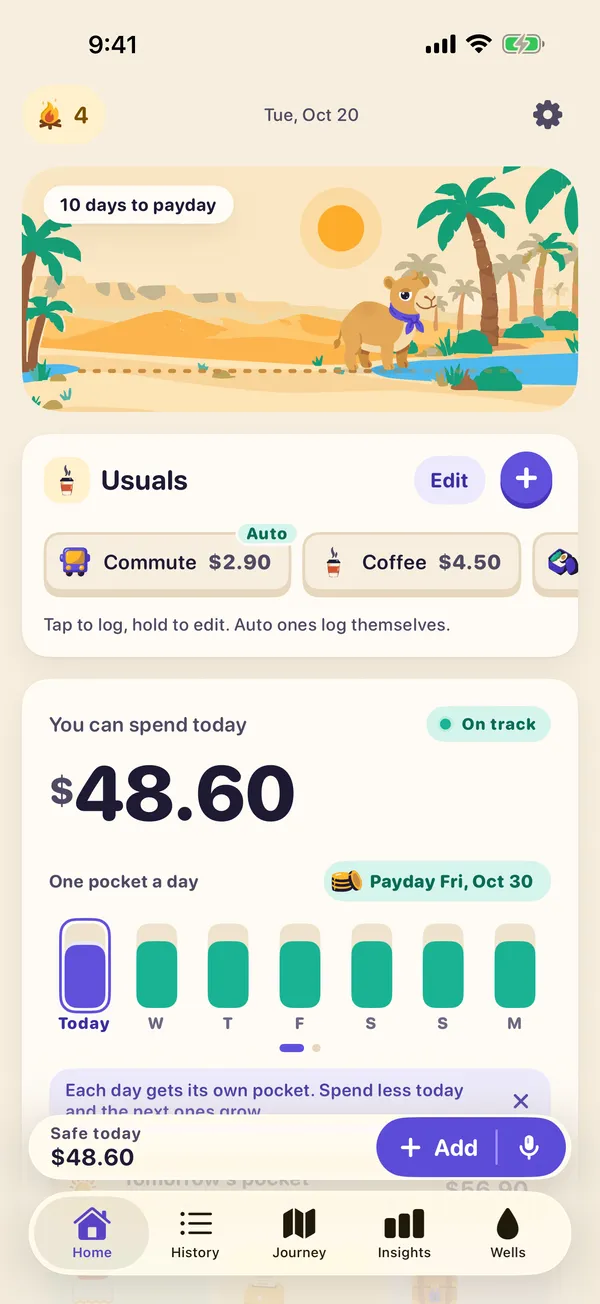
Humph shows what a buy costs your next days, and asks if each extra was worth it. No bank login, no spreadsheets. For iPhone, with a 7-day free trial.


An impulse buy feels small at the register and big on day 12 of the pay cycle. You won't beat it with willpower alone. Put a short pause between wanting and paying, and see what the buy does to the rest of your days before you tap your card.
Seven habits that cut impulse buys
- Check today's number first. Know what's safe to spend today before you open a shopping app or walk into a store. "$50 today" makes a $40 extra easy to judge.
- Wait a day for anything over your limit. Pick a line, like $30. Above it, put the item in a list and decide tomorrow. Often the urge is gone by morning.
- Remove saved cards. Delete your card from shopping apps and sites. Typing the number back in gives you ten seconds to change your mind.
- Turn off store emails and sale alerts. Unsubscribe, and switch off notifications from shopping apps. A sale you never see costs nothing.
- Give fun money its own amount. A treat you planned for doesn't count as an impulse. Set aside a fixed amount each payday and spend it guilt free.
- Log every buy the same day. Writing down "$18, sneaker socks" in the moment is a small cost, and you'll feel it.
- Rate it afterward. A day later, ask: was it worth it? Your "no" answers show which buys to skip next time.
What one impulse buy costs your week
Say you have $900 left and 18 days to payday. That's $50 a day. On Saturday you spend your $50 and add a $40 jacket you didn't plan for.
- Before the jacket: $50 a day for the next 17 days.
- After the jacket: $810 over 17 days, or $47.65 a day.
$2.35 a day is easy to ignore. Do it twice a week and the last days before payday get tight. A daily number shows the cost the same day, while you can still adjust. The daily budget formula explains the math.
Know your triggers
Impulse buys cluster around the same moments. Notice yours:
- Payday. The account looks full. Set the bills and savings aside first, so the balance you see is the money you have.
- Late at night. Tired scrolling leads to carts. Keep shopping apps off your Home Screen.
- Bad days. A treat as a mood fix is fine when it's in the plan. Use your fun money for it.
- Free shipping thresholds. Adding $12 to save $6 of shipping costs you $6 more.
How a budget app helps you stop
A budget app helps most when it puts the cost in front of you before you buy, and asks how you feel about it after. Look for three things:
- One number for today, with bills and savings already taken out, so you judge a buy against real money.
- Fast logging, a tap or a sentence, so you log the buy while you still remember it.
- A look back at the buys you regretted, so the pattern shows.
In Humph, a buy you didn't plan is an Extra. After you log one, Humph asks "Worth it?". Thumbs down marks it a Mirage: money you already called not worth it. History can show only your Mirages with their total for the pay cycle, and the payday Wrap counts them up. Rent, health and giving never get the question.
Questions people ask
Is there an app to stop impulse buying?
A budget app that shows what's safe to spend today helps you judge a buy before you pay. Humph also asks "Worth it?" after each unplanned buy and totals the ones you regretted.
What is the 24-hour rule for shopping?
Wait 24 hours before buying anything above a limit you set. If you still want it the next day and today's budget allows it, buy it.
Why do I impulse buy?
Common triggers are payday, late-night scrolling, stress and sales. Notice which ones show up for you and plan around them.
See the cost before you pay
Humph shows what's safe to spend today, every day until payday, and asks if your extras were worth it. For iPhone, with no bank login.
General information to help you plan, not financial advice. Examples use US dollars; the same steps work in any currency.


