
The short answer
To budget paycheck to paycheck, set aside your bills share the day pay lands (monthly bills × 12 ÷ paychecks a year), move a small buffer out next, then divide what's left by the days until payday. Paid $1,570 every two weeks with $1,493.48 of monthly bills and $50 saved, that's $830.70 for 14 days: $59.34 a day. The buffer is the line that ends the cycle.
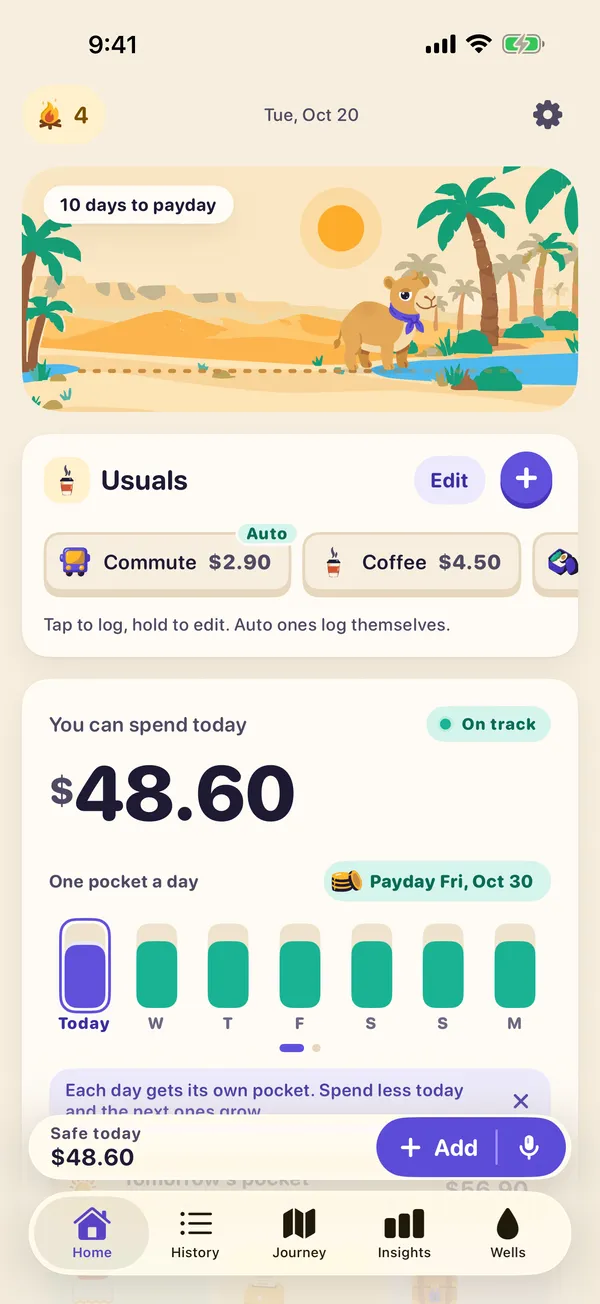
Humph holds each bill until it's paid and shows what's safe to spend today. No bank login, no spreadsheets. For iPhone, with a 7-day free trial.


Living paycheck to paycheck means each payday arrives just in time, with nothing left over from the last one. The way out is a small plan you repeat every payday: set the bills aside, save a little before you spend, and spend from a daily amount instead of your balance.
Below is a template you can copy, the steps behind it, and how to grow a small buffer so one surprise bill stops wrecking the month.
Paycheck to paycheck budget template
Fill in one copy each payday. The example is Sam, who takes home $1,570 every two weeks and has $1,493.48 of bills a month.
| Line | How to fill it in | Sam's paycheck |
|---|---|---|
| Pay after tax | What reaches your account | $1,570.00 |
| Bills share | Monthly bills × 12 ÷ paychecks a year | −$689.30 |
| Buffer | A small fixed amount, moved out first | −$50.00 |
| Left to spend | Pay minus the two lines above | $830.70 |
| Days until next payday | Count today, skip payday | 14 |
| Safe to spend each day | Left to spend ÷ days | $59.34 |
Paychecks a year: 12 if you're paid monthly, 24 twice a month, 26 every two weeks, 52 weekly. Sam's bills share is $1,493.48 × 12 ÷ 26 = $689.30.
How to use it, step by step
- List every bill with its due day. Rent, phone bill, loan payments, subscriptions, insurance. Add them up for one month.
- Move the bills share out on payday. Put it in a second account, or tell your app to hold it. You can't spend money you've already set aside.
- Move the buffer out next. Start with an amount you won't miss, even $25. Make it automatic if your bank allows it.
- Divide what's left by the days until payday. That's your number for today. Groceries, rides, takeout and coffee all come out of it.
- Check the number each day. Spend $40 on a $59.34 day and tomorrow gets a little more. Spend $90 and the days after shrink a little. You see it the same day.
This is the same split as budgeting by paycheck, with one change: the buffer comes before anything else, because it's the line that ends the cycle.
Build a buffer, then grow your savings
A buffer is money between you and the next surprise. Without one, a $300 car repair goes on a card and next month starts behind. Sam's $50 a paycheck adds up to $1,300 in a year.
- First goal: $500. That covers a lot of small emergencies. Sam gets there in 10 paychecks.
- Next goal: one month of bills. For Sam that's $1,493.48. Once you have it, one paycheck can arrive late without panic.
- Then raise the buffer line. Add $10 or $20 each time you get a raise, so your spending never feels the cut.
Why money runs out before payday
Most budgets look fine on paper. They break in the middle of the pay cycle, for three common reasons:
- You spend from the balance. $1,570 on day 1 looks like plenty. A daily amount shows that a $90 night out takes from the next two weeks.
- Big bills land on one paycheck. Rent and a loan in the same two weeks can leave a few dollars a day. The bills share above spreads them evenly.
- Small buys add up. A $6 coffee five days a week is $130 a month. You won't notice it unless you log it the day you buy it.
For more habits that stretch a paycheck, read how to make your salary last until payday.
Work out your daily amount
Type your own numbers. The calculator opens on Sam's: $1,570 every two weeks, $1,493.48 of bills and $108.33 a month into the buffer ($50 a paycheck).
The calculator averages over a full year. Your real number moves a little each payday as bills land; an app can track that for you.
Questions people ask
What does living paycheck to paycheck mean?
It means each paycheck is gone by the time the next one arrives, with no savings to fall back on if a bill or an emergency comes up.
How do I stop living paycheck to paycheck on a low income?
Start a small buffer, even $25 each payday, moved out before you spend anything. Set your bills aside the same day and spend from a daily amount. Grow the buffer to one month of bills.
Is there an app for budgeting paycheck to paycheck?
Yes. Humph counts from payday to payday, keeps each bill out until it's paid, moves savings out first and shows what's safe to spend today. It's for iPhone, with no bank login.
How big should my buffer be?
Aim for $500 first, then one month of bills. After that, keep growing your savings a little each payday.
Let the app hold the bills
Humph keeps each bill out of your spending until it's paid, moves your savings out first, and shows one number on Home: what's safe to spend today. Log a buy in a tap or by saying it, and tomorrow's number updates on its own. For iPhone, with no bank login.
General information to help you plan, not financial advice. Examples use US dollars; the same steps work in any currency.


