
The short answer
To budget semi-monthly pay, set aside half of your monthly bills from each paycheck, rent included, save a fixed amount, and divide the rest by the days until the next payday. With $1,700 on the 15th and the last day, $1,493.48 of bills and $150 saved per paycheck, that's $803.26, or $53.55 a day over 15 days. Without the split, the paycheck that covers rent leaves $26.67 a day.
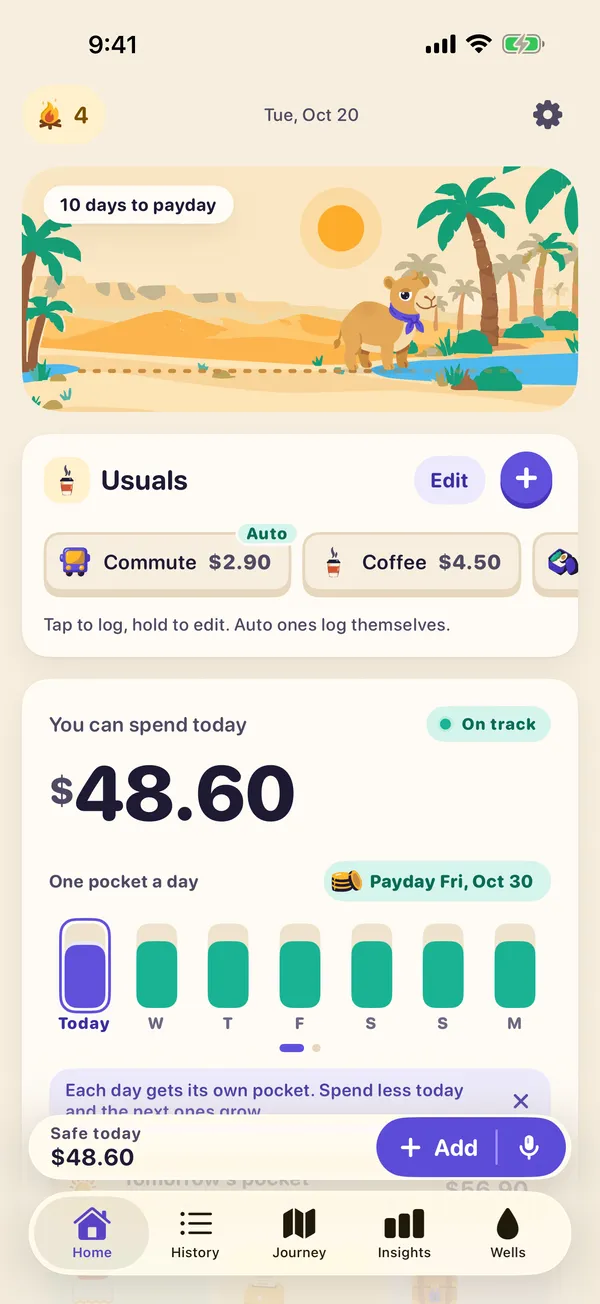
Humph knows both paydays, moves them off weekends, and shows what's safe to spend today. No bank login, no spreadsheets. For iPhone, with a 7-day free trial.


Semi-monthly pay means you're paid twice a month on set dates, often the 15th and the last day of the month. That's 24 paychecks a year, always two a month, so it lines up with monthly bills better than biweekly pay does. The catch is rent: it's due on the 1st, and one paycheck usually can't carry it alone. Here's how to plan both paychecks, with an example and a calculator.
Semi-monthly or biweekly?
| Twice a month (semi-monthly) | Every two weeks (biweekly) | |
|---|---|---|
| Paydays a year | 24 | 26 |
| Payday falls on | Set dates, like the 15th and the last day | The same weekday, often Friday |
| Paychecks a month | Always 2 | Usually 2, sometimes 3 |
| Days between paydays | 13 to 17 (15 on average) | Always 14 |
Same yearly pay, different paychecks: $40,800 a year after tax is $1,700 twice a month, or $1,569.23 every two weeks. If you're paid every other Friday, read our biweekly budget guide instead.
The rent paycheck problem
Sam takes home $1,700 on the 15th and on the last day of the month. Bills come to $1,493.48: rent of $1,150 on the 1st, and $343.48 of phone, streaming, gym, cloud storage and a loan payment later in the month. Sam saves $150 from each paycheck.
Give each paycheck the bills due before the next payday, and the two halves look nothing alike:
| Paycheck | Pay | Bills | Save | To spend | Per day |
|---|---|---|---|---|---|
| Last day (covers rent) | $1,700.00 | $1,150.00 | $150.00 | $400.00 | $26.67 (15 days) |
| 15th | $1,700.00 | $343.48 | $150.00 | $1,206.52 | $75.41 (16 days) |
Two weeks of plenty, then two weeks of noodles. Most people overspend the easy half without noticing that it was paying for the hard one.
How to budget semi-monthly pay
- Add up your monthly bills ($1,493.48 for Sam).
- Set half aside from each paycheck: $746.74. Keep it in a separate account and pay every bill, rent included, from there.
- Save from both paychecks, the day each one lands: $150.
- Divide the rest by the days until the next payday. $1,700 − $746.74 − $150 = $803.26. That's $53.55 a day over a 15-day half, or $50.20 over a 16-day half.
- Move paydays off weekends. When the 15th or the last day falls on a Saturday or Sunday, most employers pay on the Friday before. Count from the day the money arrives.
Every half of the month now looks the same. Rent week stops being a crisis because rent was half paid two weeks earlier.
Semi-monthly budget calculator
It opens on Sam's numbers: $1,700 twice a month, $1,493.48 of bills and $300 a month saved. Change any amount. The calculator spreads the year evenly, so its daily number ($52.81) sits between the 15-day and 16-day halves above.
A semi-monthly budget template
| Payday | Pay | Half of bills | Save | To spend | Per day |
|---|---|---|---|---|---|
| Fri, Oct 30 (31st is a Saturday) | $1,700.00 | $746.74 | $150.00 | $803.26 | $57.38 (14 days) |
| Fri, Nov 13 (15th is a Sunday) | $1,700.00 | $746.74 | $150.00 | $803.26 | $47.25 (17 days) |
| Mon, Nov 30 |
November in 2026 shows why you count days, not halves. Both paydays move to a Friday, so the first stretch shrinks to 14 days and the second grows to 17. Same money, $10 a day apart.
Common semi-monthly budget mistakes
- Treating it like biweekly. There's no third paycheck. Don't plan for a bonus that never comes.
- Paying rent from one paycheck. Split it, or the other half of the month has to make up for it.
- Forgetting weekend paydays. A payday moved to Friday makes that half longer, and the next one shorter.
- Dividing by 15 every time. Weekend paydays stretch a half to 17 days or shrink it to 13. Count the real days.
Questions people ask
What's the difference between semi-monthly and biweekly pay?
Semi-monthly pay comes twice a month on set dates, 24 paychecks a year. Biweekly pay comes every other week on the same weekday, 26 paychecks a year, so two months a year bring a third paycheck.
Which paycheck should pay rent when I'm paid twice a month?
Split it: set half of the rent aside from each paycheck. If the paycheck at the end of the month pays all of it, that half of the month is far tighter than the other.
How do I budget if payday falls on a weekend?
Count from the day the money arrives. Most employers pay on the Friday before a weekend payday, which makes that stretch longer and the next one shorter. Divide by the real number of days.
How much is $1,700 twice a month per year?
$40,800 a year: 24 paychecks of $1,700. Paid biweekly, the same yearly pay would be $1,569.23 every two weeks.
A budget app for twice-a-month pay
Humph knows your two paydays and moves them off weekends the way your employer does: the Friday before, the Monday after, or the date itself. On each payday it sets aside the bills due before the next one, saves first, then shows what's safe to spend today. For iPhone, with no bank login and a 7-day free trial.
General information to help you plan, not financial advice. Examples use US dollars; the same steps work in any currency.


